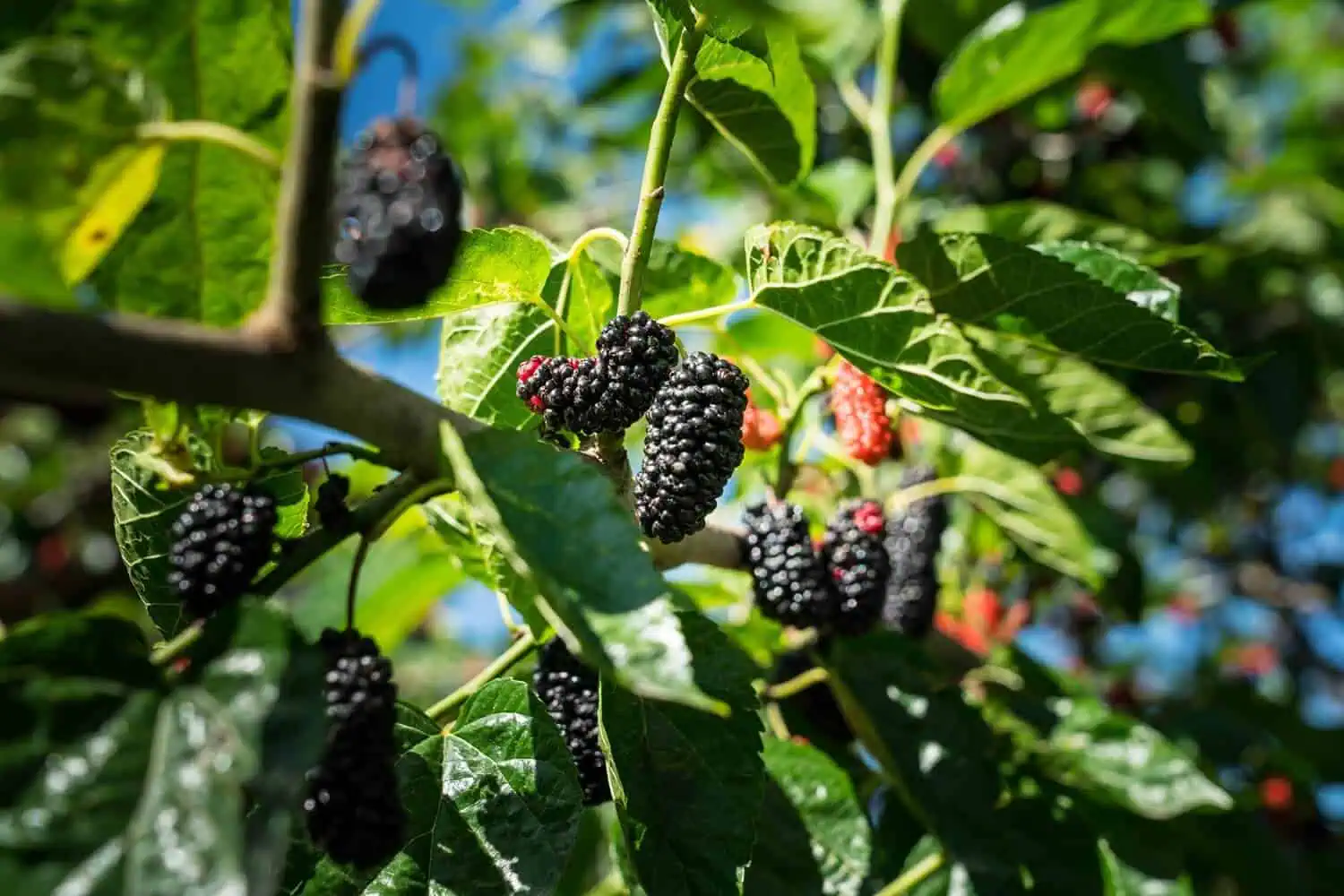
Did you know that in some regions, blackberries are invasive and considered weeds?
Well, if planted in the ground and left unchecked, they will sprawl across hedgerows, climb fences, and invade areas where they may not be desirable.
Besides, blackberries can send out long canes that seem to double in size overnight, forming thick, tangled brambles that birds hide in. That’s why, although it’s often a great idea to plant them in the garden and let them grow freely, they colonize areas quite fast.
Therefore, planting these plants in pots offers several advantages, including controlling their growth, utilizing limited space, and growing them even in unsuitable hardiness zones.
Let’s break down all the tips and tricks for growing and caring for blackberries in pots.
Blackberries Growth Habit
Also known as Blamble (Rubus fruticosus), blackberries grow on a two-year cycle and can be trailing, semi-trailing, or erect.
The first year, they develop fresh vegetative green canes, called primocanes. These are strictly for photosynthesis and developing the energy required for future growth, and they grow aggressively.
In the second year, those same canes become floricanes, which then flower and produce berries. After which, they’ll be done.
In the ground, this system spreads naturally. In a pot, though, all of that energy is confined. That means if you don’t manage those canes properly, you end up with a crowded plant that’s full of old wood and low on fruit.
So right from the start, the goal is to keep that cycle moving smoothly inside a container by employing specific strategies, which we’ll discuss later.
If done right, one blackberry plant can easily supply up to 10 pounds of delicious berries each year.
How to Grow and Care for Blackberries in Pots
Choosing the Right Variety
Some blackberry varieties or cultivars are better suited for containers than others.
Compact or thornless varieties tend to behave better in pots. They’re easier to manage and are less aggressive. Varieties like “Apache,” “Navaho,” or “Ouachita” are often recommended because they stay more contained and don’t demand as much space.
Thornless types also make a difference here because container growing means you’ll be interacting with the plant more often, turning the pot, adjusting supports, pruning, and harvesting at close range.
Therefore, the importance of choosing an appropriate cultivar can’t be overstated.
If you want to explore more varieties, check out this list.
Container (Pot) Selection
Blackberries require more space to accommodate their roots as well as their vigorous growth.
Also, when selecting the pot, you need to think about stability because once the plants are loaded with fruit, they can pull the container off balance, especially in the wind
To achieve those objectives, you want a pot that’s at least 15 to 20 inches wide and deep. If you have to err, let it be on the bigger side.
While at it, drainage is still important because if water sits at the bottom, roots rot. Terracotta pots breathe better, but plastic retains moisture longer.
Either works, as long as drainage holes are doing their job.
Ideal Potting Soil
Blackberries aren’t fussy, but they do have preferences. They like soil that drains well but still holds enough moisture to stay slightly damp with a pH of 5.5 - 6.5.
A good mix is potting soil combined with compost and a bit of perlite or sand. That balance gives you structure, nutrients, and airflow.
If the soil stays soggy, roots struggle to get enough oxygen. If it dries out too fast, the plant gets stressed, and that affects the general yield.
Planting Your Blackberries
Planting a blackberry in a pot is refreshingly straightforward.
Set the plant at the same depth it was growing before in its nursery bag. Don’t bury the crown too deep, and don’t leave roots exposed. Fill in around it, press the soil gently, and water thoroughly.
The firming and watering help the soil to settle and remove any air pockets, giving the roots immediate contact with moisture.
Optimum Light Conditions
While most fruit bushes are comfortable with medium light to partial shade, Blackberries require sufficient sunlight to thrive and produce quality fruit.
Aim for at least 6 to 8 hours of direct sun each day. Less than that, and you’ll still get growth, but fruit production drops, and the berries may lack sweetness.
If your space is limited, or growing on a patio or balcony, place the pot where it gets the longest, strongest light. Even shifting it slightly can make a difference.
Watering and Moisture Balance
Just like other potted plants, blackberries in pots dry out faster than those in the ground. That means you’ll need to check the soil regularly, especially in warm weather. Stick a finger in the soil. If the top few centimeters feel dry, it’s time to water.
During hot weather, this might mean watering more often than you expect. The plant is growing fast and producing fruits on top of that.
Here’s how to water potted plants correctly.
Fertilizer Application
Blackberries aren’t heavy feeders, but they do appreciate a boost, especially in a container where nutrients don’t replenish naturally.
A balanced fertilizer in early spring helps kickstart growth. Then, a light feeding during the growing season supports fruit development.
Too much fertilizer, though, leads to lots of leaves and fewer berries. And we’re not growing these for the leaves.
Training and Support
Even compact varieties can get a bit untidy and bendy. Left alone, the canes tangle, cross over, and shade each other.
A simple trellis, stake, or support frame keeps the canes upright and prevents them from spilling over the pot. It also improves air circulation, which reduces disease risk.
Plus, harvesting becomes much easier when the plant isn’t tangled.
Try separating canes by age. New primocanes on one side, fruiting floricanes on the other.
Pruning the Blackberry Bush
If you want to keep your plant productive year after year, pruning is essential. Because here’s the thing: Blackberries produce fruit on specific canes, and once those canes are done, they won’t produce again.
Instead of keeping unnecessary growth, cut back the old fruiting canes after harvesting. Pruning encourages new canes, which will carry next year’s crop.
If you skip this practice, the plant becomes crowded with old wood, no new growth, and fruit yield drops significantly.
Watch out for Birds
I don’t know about you, but for most people, growing blackberries means having to harvest fresh fruit for your kitchen use.
But here’s the part that catches a lot of people off guard.
You wait patiently all season for the berries to ripen. You’re checking them daily, maybe even planning when to pick them. Then one morning, they’re gone or pecked into little leftovers by birds.
That’s because birds love blackberries as much as we do since they’re dark, visible, soft, and ripen in clusters that are easy to perch on. To a bird, it’s basically an open buffet.
To prevent this, drape a bird netting over the plant as the berries begin to ripen, not after they’re already disappearing.
Common Pests and Their Control
Blackberries attract a few familiar troublemakers, especially in warm conditions.
Aphids are common. They cluster on new growth, feeding on sap and leaving behind sticky residue. You might notice curled leaves or a shiny film. A strong spray of water or insecticidal soap usually keeps them in check.
Spider mites are harder to see but more likely to appear in dry, dusty conditions. Fine webbing and speckled leaves are the giveaway. Increasing humidity and rinsing the plant with water helps disrupt them.
Then there are fruit flies or beetles that go after ripening berries.
Often, they’re drawn in by damaged fruit, which is another reason why you should protect the berries from birds. The key with pests is early detection and control.
Common Diseases and Management
Most blackberry diseases in pots come down to one thing: excess moisture combined with poor air circulation.
Fungal issues like powdery mildew can appear as a white coating on leaves. Rust shows up as orange spots. Both spread more easily when the plant is crowded or stays damp for long periods.
Good spacing between canes, proper pruning, and watering at the soil level instead of over the leaves go a long way in preventing this. Root rot is another risk if drainage is poor. If the plant looks wilted despite wet soil, that’s often the culprit.
Conclusion
There’s nothing more refreshing than fresh blackberries harvested directly from your container garden. And you have just learned how to grow and care for them.
I hope you’ve enjoyed today’s post. I’d appreciate it if you could give it a share, but no hard feelings if you don’t.
Either way, I’m glad to have you around.